
The 4Cs of Diamonds
When it comes to diamonds, excellence is measured with precision. The 4Cs represent the most internationally accepted system for evaluating a diamond’s quality. Developed by the Gemological Institute of America (GIA) in the mid-20th century, this framework is based on four essential criteria: Cut, Colour, Clarity and Carat. Together, they provide a universal language for assessing beauty and rarity in fine jewellery.
Cut
Cut determines how a diamond interacts with light, and ultimately, how much it sparkles. Unlike the shape – such as round, princess or pear – the cut refers to the proportions, symmetry and polish of the stone. It is the only one of the 4Cs that depends entirely on craftsmanship, and it plays a central role in revealing the stone’s brilliance.
A finely executed cut reflects light brilliantly, producing the iconic fire and scintillation. A poorly cut diamond, even if it scores highly in other areas, may appear dull. Cut grades range from Poor to Excellent, with higher grades offering superior levels of brilliance, fire (flashes of coloured light) and scintillation (contrasts between light and dark areas).
The round brilliant cut, with its 57 or 58 facets, remains the most popular due to its light performance. Other admired cuts include the princess – square-shaped and highly reflective – and the pear, noted for its graceful elongation.

Colour
For colourless diamonds, the less colour, the greater the value. The GIA grading scale runs from D (colourless) to Z, where hints of yellow or brown become more noticeable.
Grades D, E and F represent stones of exceptional rarity, while diamonds graded G to J are nearly colourless and offer excellent value. Beyond this, warmer tones become visible – particularly in settings that expose the stone more directly to the light.
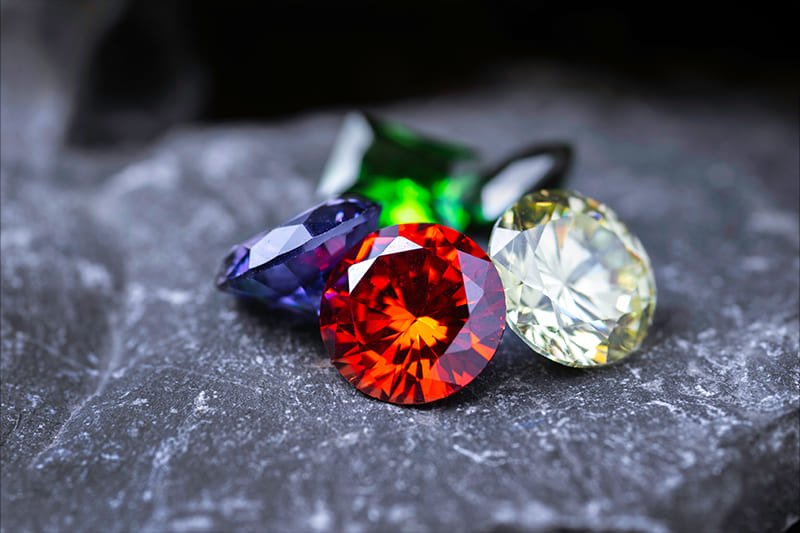
Although most natural diamonds contain minor traces of colour, the top grades are especially sought after in high-end jewellery. Conversely, rare “fancy” coloured diamonds – such as vivid blues, pinks or reds – are valued not by this scale, but by the intensity and uniqueness of their hue.
Clarity
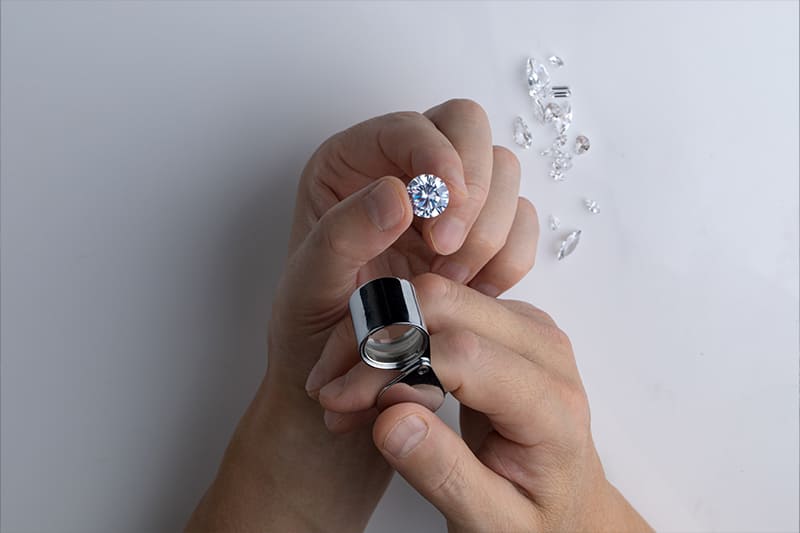
Clarity refers to a diamond’s internal and external purity. Assessed under 10x magnification, it takes into account inclusions (internal features) and blemishes (surface irregularities). The fewer the flaws, the more transparent and luminous the diamond appears.
The GIA clarity scale ranges from FL (Flawless) to I3, where inclusions are clearly visible to the naked eye. In between are levels such as IF (Internally Flawless), VVS (Very, Very Slightly Included), VS (Very Slightly Included), SI (Slightly Included) and I (Included).
In practice, diamonds graded VS1, VS2 or even SI1 often appear clean without magnification, especially when well-cut and properly set. The grading process is deliberately conservative to avoid overestimating clarity.
Carat
The carat (ct) is the unit used to measure a diamond’s weight. One carat is equivalent to 0.2 grams. Although weight and size are related, the cut affects how large a stone appears – a shallow or deep cut may alter perception without changing the actual carat weight.
Smaller diamonds may weigh as little as 0.01 ct, while popular mid-range sizes include 0.25 ct and 0.50 ct. A one-carat diamond is a common benchmark, with stones exceeding 2 ct considered particularly rare.
It’s important to remember that value isn’t based solely on weight. Two diamonds of identical carat weight can differ greatly in price depending on their cut, colour and clarity. Additionally, the expertise involved in sourcing and cutting top-grade diamonds adds significantly to their overall worth.
Diamond Jewellery in Gibraltar – The Red House
At The Red House, you will find a refined selection of diamond jewellery in Gibraltar. Our collection includes bracelets, earrings, necklaces, rings, and pendants, each carefully chosen for its beauty and craftsmanship. You are welcome to visit us at 68-70 Main Street, GX11 1AA, Gibraltar, where our team will be pleased to assist you in finding the perfect piece.