Everything you need to know about rubies
Ruby is one of the most recognisable gemstones in jewellery for a technical reason, it is the red variety of corundum, a mineral that combines high resistance to scratching with good performance in everyday wear.
In practical terms, its hardness helps the surface retain its polish and lustre over time, and its crystalline structure, reduces the likelihood that the stone will split “cleanly” from a blow, something especially relevant in high jewellery pieces intended to be worn frequently.
The red colour, for its part, is not a “mysterious” or variable attribute, but the result of a chemical process, within the corundum crystal, small amounts of chromium replace some of the aluminium in the crystal lattice. That substitution changes how the mineral absorbs and transmits light, producing the characteristic red hue.
Understanding what a ruby is means knowing its composition, its geological formation, the quality criteria, and the treatments usually applied for its proper care.
What a ruby is and how it is defined
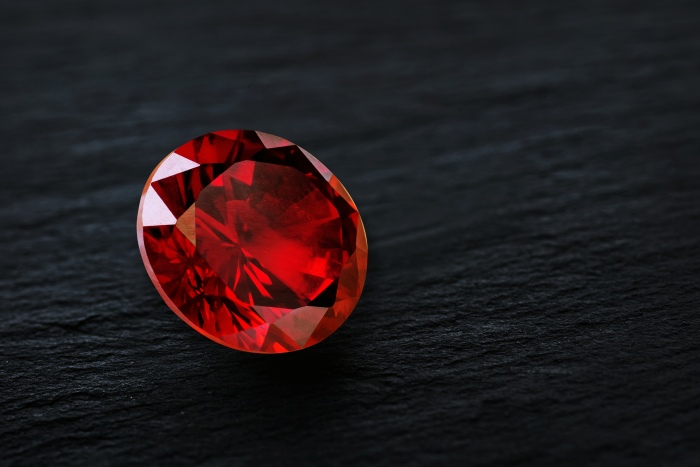
Ruby is the name given to the red variety of corundum, whose composition is aluminium oxide (Al₂O₃). The element that causes the red colour is chromium present in trace amounts. When corundum presents other colours, it is marketed as sapphire. In practice, the line between “ruby” and “pink sapphire” can vary depending on laboratory and market criteria, so, for valuable gems, it is advisable to support the designation with gemmological documentation.
Gemmological properties relevant in jewellery
Corundum has hardness 9 on the Mohs scale, which contributes to its resistance to scratching and favours its use in frequently worn pieces. In addition, it is a gemstone with good toughness, that is, with a relatively high capacity to withstand impacts without fracturing easily.
Added to this is that it does not exhibit marked cleavage, unlike other minerals that have internal “planes of weakness” along which they tend to split cleanly if struck, corundum does not break along a preferred plane. In practice, this means that, in the event of an impact, it is unlikely that the ruby will open up into a neat and complete break along an internal plane, which is an advantage in jewellery.
In natural rubies inclusions are common, which are small internal features formed during the growth of the gem. Some, such as so-called “silk” (very fine needles), can reduce transparency. In certain cases, if those inclusions are oriented in a regular pattern, they produce asterism, the “star” effect, which is best seen in cabochon cuts.
In addition, inclusions are not always a drawback, as they also help confirm the ruby’s natural origin and identify possible treatments.
Formation and common provenances of rubies
Rubies form in primary deposits (in the host rock) and secondary (alluvial) deposits, where erosion releases the crystals and concentrates them in gravels, which facilitates extraction. Geologically, two main environments stand out: rubies associated with marbles, which tend to have less iron and may show a more pronounced red fluorescence, and rubies related to basaltic, which tend to incorporate more iron, which can darken the tone and reduce fluorescence. Between the two there is an intermediate group common in today’s market, associated with amphibolite-type rocks.
These differences influence the type of inclusions and the composition of the ruby. Therefore, when origin matters for value, laboratories combine microscopic observation with trace-element analysis to support the determination of provenance and provide a more reliable diagnosis.
How the quality of a ruby is evaluated
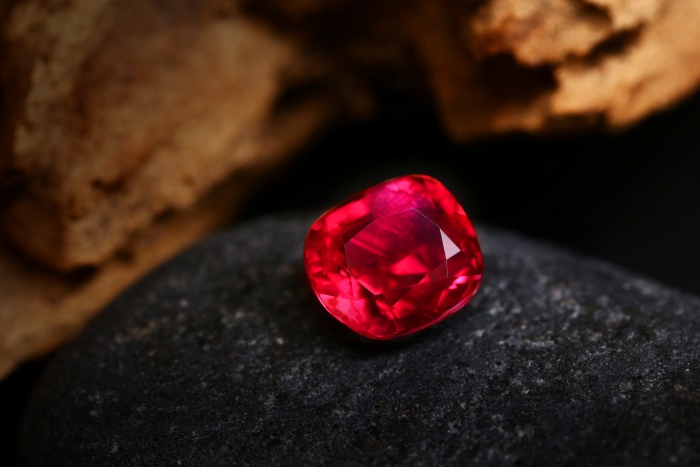
In coloured gemstones, the main quality factor is usually colour. The combination of hue, tone and saturation. A ruby that is too dark can lose apparent brightness; one that is too light can appear closer to a pink sapphire. The assessment is preferably carried out by viewing the stone “face-up” under controlled lighting, as the environment can alter the reading of red.
In this context the term “pigeon’s blood” is sometimes used to describe a specific range of red. It is not a universal category and may be applied with different criteria depending on the market or the issuing body.
Therefore, in high jewellery pieces it is worth considering it a commercial descriptor which, if used, should be backed by technical criteria and, where appropriate, gemmological documentation.
The clarity is assessed by the quantity, the type and the position of inclusions, bearing in mind that completely “clean” rubies are uncommon in relevant sizes. The cutting influences the light return, the colour uniformity and the appearance of brilliance. In ruby, it is often prioritised to retain weight and chromatic quality over ideal proportions, especially in fine material. The size is also decisive, all else being equal, the value tends to increase with size, because large, high-quality rubies are scarce.
Uses of ruby in jewellery and watchmaking
In jewellery, ruby is used in rings, earrings, pendants and bracelets. Its characteristics make it perfect for frequently worn pieces, provided the design adequately protects the vulnerable areas of the cut. In shapes with points or sharp corners, a setting that covers or shields those areas reduces the risk of damage.
In mechanical watchmaking, the term “ruby” also appears in a technical sense. Many movements incorporate “jewels” which are usually synthetic rubies or sapphires used as bearings to reduce friction and wear at specific points. In this case they are not decorative gems, but functional components made with precision.
Care and maintenance of ruby
In rubies without treatments that affect fractures, reasonable cleaning consists of warm water, mild soap and a soft brush, with thorough rinsing and drying with a non-abrasive cloth. If the stone has fillings or treatments that modify fractures, it is advisable to avoid ultrasonic cleaning, steam and exposure to workshop heat, as these can compromise the stability of the filling material or worsen fissures.
When the treatment is unknown, it is preferable to have a professional check before any intervention, such as cut adjustments, repairs or work on the setting.
In storage, it is advisable to keep the piece separate from other items. Although ruby is hard, it can scratch softer gems, and in turn it can suffer micro-damage if it rubs against diamonds or other very hard materials.
Meanings of ruby as a precious stone
Ruby has historically been considered a stone associated with the idea of value and prestige, partly because of its scarcity in fine qualities and the difficulty of obtaining large specimens with good colour.
In many cultural traditions it has been linked to power and social standing, which explains its recurring presence in ceremonial jewellery, ornaments of the court and pieces intended to represent status.
On a symbolic level, ruby has been associated with concepts such as vitality and strength, an association consistent with its characteristic colour and its use in jewellery as a centre stone.
Its role as July’s birthstone in extended lists in contemporary jewellery is also relevant, which has consolidated its presence in pieces associated with personal celebrations and anniversaries.
High jewellery selection at The Red House
At The Red House, an established luxury jewellery brand in Gibraltar, we select rubies and jewellery pieces prioritising verifiable gemmological characteristics and a presentation consistent with the standards of a luxury jeweller.
If you would like guidance on which ruby jewellery piece to choose, the team at The Red House can advise you on anything you need.